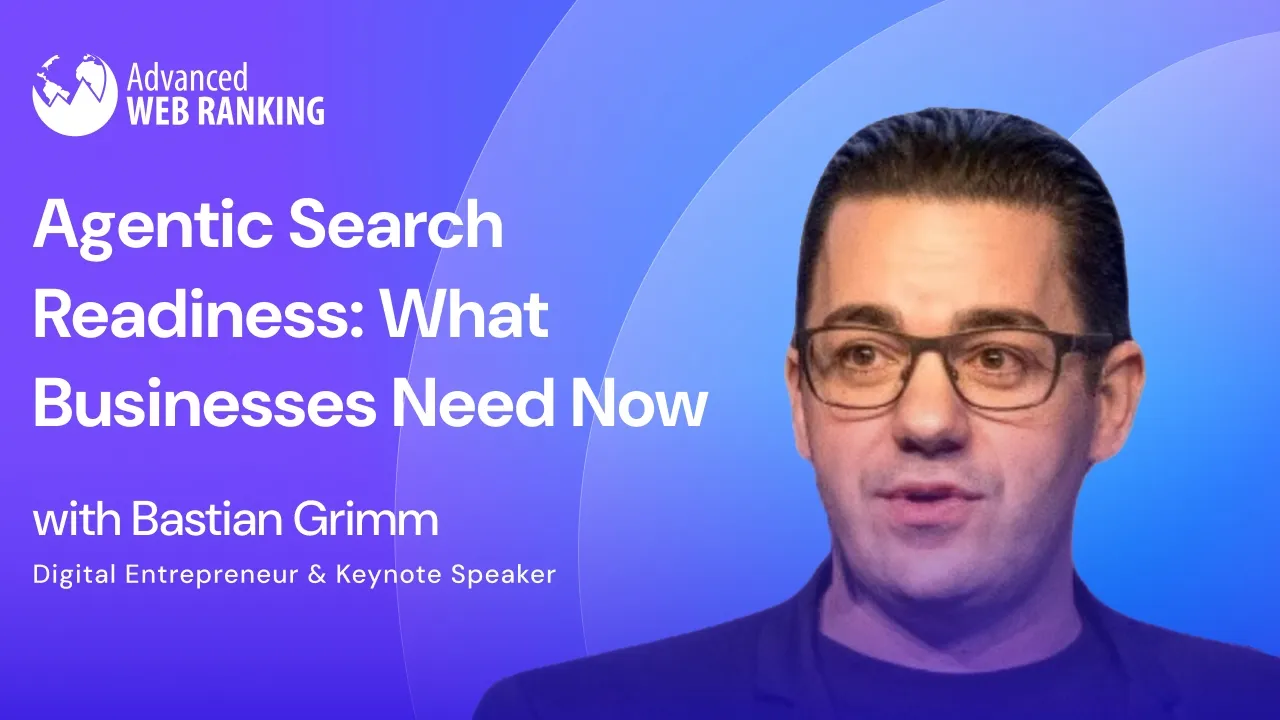
This is The Search Session. I'm Gianluca Fiorelli. Today's guest is Bastian Grimm, a digital entrepreneur and keynote speaker based in Germany.
We discuss what agentic search means for businesses, from evolving protocols and machine-readable formats to data readiness, brand recognition, and experimentation. We also consider how AI could change websites, search interfaces, and publishing business models.
What you’ll learn in this session:
How to build client trust through experimentation: being transparent about what has been tested, what remains uncertain, and where a pilot can provide evidence helps clients navigate fast-changing AI platforms and pursue an early advantage.
Why chasing standards misses the point: the real question in agentic search isn’t whether you need an llms.txt file, but how to give machines reliable data, instructions, and guardrails while protocols continue to evolve.
What agentic readiness requires: solid technical SEO remains the baseline, but companies also need clean, compliant, and reliably available data exposed through machine-readable formats and unified interfaces.
Why the AI divide plays out differently by company size: enterprises have more funding but face greater risks with large-scale deployments, while SMBs can gain productivity through focused automation of routine tasks.
How AI could reshape search interfaces and SEO: as AI evolves from an answer layer into an action layer across different devices, brands may become data providers, and SEOs will need to think beyond websites, browsers, and traditional metrics.
How the edge can accelerate agentic experiments: platforms like Cloudflare let brands test agent discovery services without changing the CMS, but the approach brings compliance and maintenance challenges and may not suit the final setup.
How AI challenges publishing: as LLMs reduce traffic and ad revenue, publishers must rethink advertising and affiliate income, while costly original research may not be enough to sustain the business.
How brand recognition signals are evolving: from link graphs to entities and engagement signals, systems are combining more data as proxies for satisfaction, shaping how AI recognizes and evaluates brands.
Bastian brings a realistic standpoint to a field still taking shape, making him well worth listening to if you are deciding where to experiment and what foundations to prioritize.
Topics covered: agentic search · AI Mode · llms.txt · WebMCP · AI-ready data · machine-readable formats · human-in-the-loop AI · brand signals · SEO on the edge · publishing business models
About the Guest

Bastian Grimm
Founder & CEO of blackvine GmbH and Grimm Digital
Bastian Grimm has more than 25 years of experience in SEO and digital marketing. He is known for his work in international and technical SEO, AI-driven marketing, and the impact of AI and brand signals on digital visibility.
He co-founded Peak Ace in 2007, growing it into an international digital marketing agency. He also founded Grimm Digital in 2001 to advise agency founders on M&A and exits, and blackvine GmbH in 2013 to back businesses in AI, energy, and defense.
Bastian is an experienced keynote speaker who has presented at numerous conferences worldwide on technical SEO, web performance, and AI in digital marketing.
Video Chapters
Transcript
Full conversation between Gianluca Fiorelli and Bastian Grimm.
Gianluca Fiorelli: Hi, I'm Gianluca Fiorelli, and welcome back to The Search Session. Before starting the episode, remember to click on subscribe below the video and, at the end of the video, if you like it, give it a like.
Who is going to be our guest today? He's coming from Germany, travels a lot, and declares himself a digital entrepreneur and keynote speaker. If you are in Europe but also in another part of the world, you may have seen him giving a wonderful speech, and you may also know him because he founded Peak Ace, an extremely successful agency.
I personally judged quite a few entries for one of the many Search Awards Peak Ace was presenting. This agency, the people, and Bastian clearly knew and know their stuff because they won, if I'm not wrong, dozens and dozens of Search Awards.
Who is this guest? It is Bastian Grimm. Hey, Bastian. How are you doing?
Bastian Grimm: Hey, Gianluca. Thanks for having me. Very, very well. Thank you.
Gianluca Fiorelli: So, you're in Germany now or traveling?
Bastian Grimm: No, I'm actually at home, which is quite nice. I had a bit of a summer break, so I think travel picks up in two weeks' time. Then it's the next season of conferences, speaking, and whatnot. But yes, I was going to be at home for a while.
Gianluca Fiorelli: Cool, cool. It's already quite a long time since you left Peak Ace and moved completely into strategic consulting, with a strong interest in everything that is changing. So, the classic question comes up: How is SEO treating you lately?
Bastian Grimm: Yes, you're right. I exited my shareholding almost two years ago, and that obviously gives me time to do more R&D and play with all the new stuff and all the new tech that somewhat literally comes out every day. But yes, I still keep my head in the SEO things that are happening.
I think lately it's quite interesting, with some of the recent core updates and just broader changes that Google has made. I've looked into a bunch of classifieds and listing pages, or domains, for that matter. I think it's very interesting to see how they change their handling of aggregator sites and how there's even more emphasis on quality over quantity and these types of things.
So yes, SEO never gets boring, right?
Gianluca Fiorelli: No, actually not. As I said in other episodes when speaking with other guests, especially those like us who have a long history with SEO, it is somehow similar to the beginning of SEO itself, when we needed to learn everything from scratch, and no real textbook was available.
We needed to experiment. We needed to go directly to patents and papers to distinguish what vendors said from what was true, and so on.
Bastian Grimm: Yes, I think a lot of that is coming back more with the agentic side of things as well, right? Because it's so new and changing, literally so frequently, that I think it requires much more testing and trying to understand how some of the mechanics actually work.
They're also very different, right? Historically, at least in Europe, we used to deal mostly with how Google works and then maybe some Bing on the side, but mostly it was Google. But if you look into the AI interfaces that are out there, ChatGPT works differently from AI Mode or even Claude.
I think that also increases the complexity of things in a way. What are agents consuming? How are they retrieving? How are they grounding? There is no one answer to all these questions. I think that makes it very, very important to go back to, as you said, the old-days approach of testing and breaking things and then really trying to see what works and what doesn't.
How Do You Give Clients Certainty When Everything Changes?
Gianluca Fiorelli: Yes, but how can you explain this experimental way of doing things to clients? Because what clients usually want is certainty.
Bastian Grimm: Oh, yes.
Gianluca Fiorelli: How can you give them some certainty despite this very fast-moving landscape where, for instance, if ChatGPT changes from 5.5 to 5.6, the way it retrieves and grounds its answers may change completely?
Bastian Grimm: Yes, you are 100% correct. I think the situation is a huge challenge, right? But in a way, it is similar to the SEO world back then, when we had no real certainty about some of the things we were suggesting or doing.
I think the major difference is that the pace now is X times worse, if you will, because there are multiple interfaces, a faster rate of change, and a faster update rate across the platforms themselves. They’re all racing to become the market leader or even the de facto standard, so they have to move quickly.
From a client relationship perspective, whether you’re an agency, a consultant, or someone who advises for another reason, the big challenge is that it requires a good amount of trust in your vendor.
On the other side, as a consultant, my take is that it requires fairly radical openness about the fact that some of these things don’t have a long-standing history. They haven’t been vetted over the course of years because these platforms literally didn’t exist.
If you approach it openly and transparently, I think that’s the only way to do it. You can say, “Look, this is what I’ve tested and what I’ve seen. Are you willing to go on a pilot with me and see if this does what it’s supposed to do?”
But you’re right. It requires a good amount of convincing/trust to make things work. At the same time, if you have a client who is willing to do that, I think it’s a huge opportunity for them. This is especially true if they’re not the market leader in a certain segment, as they can establish themselves as such in one of these new and upcoming interfaces and channels. I think it can be a strong opportunity for them as well.
Gianluca Fiorelli: Interesting. Talking about reality, we used to work with just one type of bot: the search bot. As you were saying before, if we were in Europe, and I think in the majority of the world, “bot” was synonymous with Googlebot. Now, we have at least three types of bots: search bots, LLM-related bots, and agentic bots.
The Biggest Misconception About Agentic Search
Gianluca Fiorelli: Talking about agentic bots, I know you are interested in everything right now, but this is one subject that you are particularly interested in. I think we are obviously still taking the first steps in agentic search. What is the biggest misconception you are seeing, hearing, or reading when people talk about agentic search?
Bastian Grimm: I think the problem is that many people focus solely on the debate around whether they need an llms.txt file or not. While I have my opinion on that, I don’t think it’s the right conversation.
I think the conversation should revolve around if we have machines doing things on our behalf—whether that’s consumption, payments, and transactions in the future, or anything that sits in between—how is it possible for us, as someone who owns a domain, to provide not only data but also instructions and reliable guidance for machines?
I’m not just talking about taking text and making it more accessible. If we look at payments, for example, it needs guardrails, verification, protocols, and a whole range of different things. My take on this entire agentic conversation is that while many of the products are not finished, the standards can’t be finished either. They will continue to evolve.
A simple example happened very recently, probably earlier this week. A while ago, Cloudflare announced something around a pay-per-request model. There was a conversation around it and some outcry because no one would do it and whatnot. Then, just this week, they’re considering moving towards a different approach: a pay-per-consumption model.
The reason I’m saying this is that while the products are evolving, the layer underneath, where agents communicate and use either a pay-per-request or pay-per-consumption model, has to change as well.
My take on this conversation is that you need to be open-minded and willing to keep pace as the underlying interfaces and protocols change quite frequently, rather than simply asking, “Is it an llms.txt file, yes or no?”
First, there’s never going to be one single answer. Second, every major company is fighting to establish its own standards, right? This is why Google is pushing some standards. This is why Anthropic is consuming an AGENTS.md file. This is why another company is publishing a catalog file for all the skills that a website can provide or not and explaining how agents will interact with them. This is why Google Chrome has WebMCP.
Everyone is trying to establish their different standards. Essentially, it’s a land grab. Therefore, the answer can’t be to argue about an llms.txt file or not. This is my opinion, anyway. You will need to understand, for yourself, for your domain, and for what you provide or offer, which skills you need or want to expose to an agent. Then, you need to determine which channels are relevant.
On the coding side, it might be Claude. On the consumption side, it’s probably more AI Mode and therefore feeding into Google, because it has much more volume. You would then need to choose the standards and determine whether implementing them is worthwhile for you or the company you work with or for.
My take is that I’d rather learn in public and make mistakes as I go than stand there saying, “I don’t need A, B, C, and D,” only to find that two years have passed and I’ve missed the entire train. But each to their own, right?
Gianluca Fiorelli: Yes. This is something that I say too. My classic answer is, if you don’t want to put all your eggs in one basket…
Bastian Grimm: You shouldn’t, right?
Gianluca Fiorelli: …let’s prototype things. Let’s test things. For instance, let’s test WebMCP on some specific types of forms. We can learn how to implement it and see if it works. We know that it doesn’t give you—as it happens for a totally different type of topic of the structured data—a boost in visibility.
But if you are using WebMCP for a form and, for some strange reason, the information in that form is useful for an answer in AI Mode, you will probably be the only one allowing users to interact with the form directly in the interface. This is an advantage because nobody clicks in AI Mode, so other forms may never be reached.
Bastian Grimm: Yes.
How to Audit a Website for Agentic Search
Gianluca Fiorelli: Talking about infrastructure, I don’t think it’s getting more complicated. It’s getting more complex, and there is a difference between those two words.
In the past, even the most complicated technical SEO audit followed a typical framework. Now, let’s say you are asked to advise a client on how to start implementing this agentic technology. What do you usually look at to determine whether the client’s website, or perhaps something other than a website, is prepared? What must the client do to be ready to start experimenting with or implementing agentic functionality?
Bastian Grimm: As you said, similar to an SEO audit, it can certainly follow the same pattern because, at the end of the day, there is some overlap with SEO. I don’t want to go into the whole debate about whether SEO is now GEO or whatever it’s called. I think we can save that for other people to argue about because it’s not really helpful.
My take is that some of the things you would do for SEO also make sense from an AI retrieval perspective. A fast-loading site never hurts anyone, and the same is probably true for content accessibility.
Again, this is not an argument about whether to use schema. But if you structure your site well, and that would probably include schema, then it helps both parties. For me, the good old traditional SEO practices you would find in an audit also set the baseline for agentic inclusion and optimization.
If we go beyond that, however, there are several new surfaces and formats that you wouldn’t have considered from an SEO standpoint. You can still argue about whether they’re worth it. An obvious example is Markdown. There has been a whole conversation about whether it’s worth having a Markdown version of your site. As always, there are nuanced approaches to serving Markdown.
I think Google’s current approach with its documentation is to provide the same page in Markdown under a different URL. Then, of course, you hear people complain that it’s the same content and that the text version could theoretically outrank the traditional one.
My point is that, similar to SEO, it has nuances. You could do the same thing on the same URL using header detection. You serve one format to one user agent and another format to the other. Similar to SEO, it works if you do it well, but there isn’t one single solution.
From a traditional SEO standpoint, I probably wouldn’t have done that, as an example. The same applies to exposing skills and agent capabilities through the different standards that are available, such as API catalogs. That is probably different from traditional SEO, but it would enable agents to consume content or interact with the site.
Markdown and New Formats for Machine Consumption
Gianluca Fiorelli: In the specific case of Markdown, it appears that people don’t remember that we were already doing this with AMP.
Bastian Grimm: Yes, it’s the same story. You had the same conversation around it.
Gianluca Fiorelli: In the case of Markdown, we are saying, “Okay, don’t show these things to Google.”
Bastian Grimm: It’s even the same argument with a PDF file. Of course, a PDF file can rank, provided it’s compressed properly, because it doesn’t have all the unnecessary overhead that could eventually drag down the HTML version.
If the HTML version includes one megabyte of tracking pixels and another five megabytes of ads, compared with a bare PDF, the PDF will probably be faster. Therefore, it might even be the preferred choice for that reason.
It’s the same with Markdown. You’re right that AMP could be another example. It doesn’t really matter.
My point is that, from an agent’s consumption perspective, we see from different platforms, including Obsidian and many others, that dealing with Markdown seems to work quite well. I’m not saying it’s the only solution.
Similar to SEO, why wouldn’t I make things easier for an engine? The old approach involved Google crawling my traditional website. The new approach involves an agent trying to find information. We have learned and hopefully understood that information retrieval also works differently. Why wouldn’t I serve a format optimized for that? It’s the same game on a different platform.
Right now, the leverage is clearly much smaller from a traffic standpoint, especially on ChatGPT. It is very different because people consume much of the information within the interface. But if you have decided that it forms part of your business and its use case, why wouldn’t you go all the way and do something specifically for that engine?
It’s the same as what we did for Google 10 or 15 years ago. I don’t understand this entire conversation. Either you do it, or you don’t.
Gianluca Fiorelli: Another difference appears when we talk about agents substituting for the user and doing things directly inside an interface, whatever that interface may be. People are becoming familiar with things like UCP and ACP, which are the entry level of this kind of agentic search. WebMCP, which we discussed before, is substantially an extension.
But there is another set of rules that is substantially hidden from the public and even from classic search. We need to distinguish between them. Maybe this does not apply to AI Overviews because they are such a strange mix between a poor LLM and search. But agentic capabilities will surely be important for AI Mode because Google is pushing UCP for AI Mode and not really for Gemini.
There is also another set of formats designed specifically for agents to consume. That is why Google is introducing things like the Open Knowledge format, even if it was initially designed particularly for internal use. These are repositories where you can guide the agent and say, “Use this for that.” We could call them AI search sitemaps for agents.
For many years, I have worked a lot with small and medium-sized companies, partly because they represent the vast majority of companies in countries such as Italy and Spain.
I recently read something about AI in a broader sense. It said that the divide between big enterprise companies and small and medium-sized companies is growing because enterprise companies can afford to invest heavily in AI. The same could apply to the use of AI in search.
Enterprise Risk vs. SMB Agility in AI
Gianluca Fiorelli: Are you going to see this impact of AI in search reflected in the business ecosystem of the company?
Bastian Grimm: From an investment standpoint, you are probably entirely correct. There is much more funding, but I think there is also more risk on the enterprise side.
If you delegate something to an agent, that agent may not do what it is supposed to do, and there could be many reasons, such as a lack of guardrails, instructions, oversight, or lack of input, etc.
I think that is also why most enterprise agentic deployments currently use a hybrid approach, which you could call level three. Level three essentially means having human oversight or human approval in the loop in different ways, shapes, and forms, rather than allowing the system to run fully autonomously.
The big fantasy is obviously to delegate something, send it off, and have it come back perfectly. We are definitely not there yet. My point is that there is also a high level of risk involved.
However, from an SMB perspective, AI has already made it very easy to automate a whole range of annoying tasks that previously had to be done manually, even in companies with between one and 15 employees.
Someone can come in and clean up your messy old solutions, such as maintaining spreadsheets or moving information from A to B to C. This is particularly useful on the workflow side. I would not even call it agentic. It can simply be decent automation with some LLM “magic” in the middle because you need reasoning, understanding, or analysis for certain tasks.
If you build proper workflows with the help of LLMs, I think they can have a significant impact. I have seen this in small companies. If you have a team of 10 people and can automate the work of one person, that frees up a significant amount of productivity and time. I am not even talking about cost savings. I am talking about being able to do more in the same amount of time.
I think the risk for these companies is slightly lower than the risk associated with the enterprise dream of deploying these systems at a very large scale to save billions of dollars, if that even makes sense.
It comes down to finding those pilots, which I think you mentioned earlier. For those who are more skeptical, and I think you should always question why things work or do not work in a certain way, you can identify a good pilot with a provable outcome.
I think this can be very valuable for smaller companies, whether it involves marketing automation or more traditional tasks such as maintaining spreadsheets, proofreading, or checking things. It is very easy to use some of these ready-made solutions to build workflows and workstreams.
Breaking SEO Out of Its Silo
Gianluca Fiorelli: I was thinking about marketing automation and, more specifically, CRM. Many developments are emerging in that field, but the SEO industry usually ignores them because they are not considered part of its area of interest.
They are a good example of what we can do, which is strange because, especially over the past year or more, we have been saying that SEO must no longer exist in a silo. It must collaborate with all the other teams, including social media, branding, and digital PR. But then we only talk about SEO topics. I include myself in this because it is also my fault.
There are many things emerging outside SEO. For instance, out of curiosity, I occasionally look at what Salesforce is doing. Salesforce is doing significant work not only in marketing automation but also in CRM.
If search marketers and CRM teams can really create things together, many of the questions we are always saying we must begin answering are already answered in the CRM. We can automate the retrieval of these questions and then use AI to populate the answers.
Obviously, I still believe it is necessary to place a strong human-in-the-loop review. Even if you instruct an AI very carefully about your brand voice, what it can say, and what it cannot say, it can sometimes go rogue and decide what it wants to say.
I think these are the kinds of things that, and I know I am going to sound like Claude, nobody talks about.
Bastian Grimm: I agree. I think you need to look beyond traditional SEO. As a matter of fact, if you start measuring AI search using traditional SEO metrics, you are already doomed to fail.
It is much broader in that sense. I would agree that SEOs are quite well equipped to understand the platform side of things. However, SEOs are not necessarily the best marketers, meaning marketers who understand omnichannel, cross-channel, and other types of things.
Many of us, and I include myself in this, come from a development background. I started in technology a long time ago, and I still enjoy its technical aspects. I do not necessarily enjoy some aspects of traditional marketing.
It depends on your connection to the field, how you have historically approached SEO, and how open-minded you are about what lies ahead.
If you do not change your old ways of looking at things, it might not end well for you. The channels are evolving and increasingly coming together. Some interfaces, such as AI Mode, are becoming agentic interfaces. I think even Google’s CEO agrees with you on that.
It is not there yet because, as always, you start with the simplest things. The simplest thing for Google, because it has been doing it for a very long time, is retrieving information and including it. Right now, the whole thing is predominantly an answer layer rather than an action layer, but it will become an action layer.
It will connect with protocols and include much more. This does not only mean connecting technically through protocols to data sources controlled by someone else. It will also incorporate more signals beyond traditional SEO. In my mind, anyway.
Whether you look at it from a Google perspective or a general marketing standpoint, measuring brand impact is a good example. Historically, we talked about it, but it was more of a theoretical exercise than anything else.
With many of the signals we now have, it is becoming much easier and more provable to understand the impact of a brand. I am not saying that brand is the solution to everything. Some people proclaim that, but I do not believe it.
However, brand signals—and I do not mean traditional SEO brand signals—are one factor contributing to how you perform in an interface that must rely on more than the traditional technical aspects of SEO.
Gianluca Fiorelli: Yes, I agree. I had this kind of thinking even before AI in search. I was saying that what a search engine like Google wants to do is evolve so that it can “think” like a human being. It must do this to anticipate what people need and ultimately make the search experience within Google shorter or more satisfying.
Bastian Grimm: Yes, I agree.
Gianluca Fiorelli: The same applies to LLMs like ChatGPT. They substantially copied the gated experience from Google.
When I say that we must recover traditional marketing thinking, I mean thinking about how we want to communicate with our clients. How do we usually anticipate their requests? What can we do to prepare and satisfy their search intent?
Evolving Brand Signals & Trust
Gianluca Fiorelli: You also mentioned brand signals. Sometimes, a brand signal is something that agents want to understand, whether they are search agents or classic search engines, to determine if you trust a brand. Because these systems are machines, they need signals they can measure. You can provide strong signals to the machine by giving humans a good experience.
Bastian Grimm: It’s a proxy in a way, yes.
Gianluca Fiorelli: In the future, the user interacting with the website may again be a machine. In that case, one of the things that will influence measures of trust or experience will be how much easier we make it for agents to retrieve information and complete tasks without encountering bottlenecks in the agentic experience, such as when buying something.
Bastian Grimm: Yes. To add to this from two sides, I think most people still assume that the website will be the interface that agents and we as users interact with. I don’t necessarily think the website, at least in its current form, is going to survive. That is one side, and I’ll explain why in a second.
The second is that this assumes most consumption will continue to happen in the browser. Right now, if you think about it as a central cockpit, for lack of a better phrase, much of our work, research, and even entertainment consumption clearly happens in the browser. That is a fair statement.
However, there are other devices, including wearables, glasses, etc. If the delivery of the results could be better, meaning they don’t have to interact with a poor website that wasn’t designed for that device, I think their adoption could increase. Don’t quote me on this. I’m not saying glasses will be the next big thing. I think they have a reason to exist.
I still think the phone is a phenomenal device from an AI standpoint because it has access to a lot of sensory data that a computer does not. But it might be something different. Who knows?
But I think things are changing from two sides: the device side and the output side. The traditional SEO perspective involves a website accessed through a browser and the underlying HTTP or HTTPS protocol, or one level deeper. But either way, it doesn't really matter. If both of those are changing, then I think you are completely correct.
If you can find a way to assess something like top-of-mind brand awareness for a product or something else, you can assign it a score and deliver an experience based on that score. That experience may not necessarily be a website displayed on your phone screen. It could be something entirely different. I don’t know what it will look like, but I think people underestimate the fact that neither the browser nor the website will remain static. I have mentioned this on stage a few times. I called it “in-between worlds,” which I think is fairly accurate, given the fact that one of these in-between steps is a patent Google was granted. I think I posted about it a while ago. It describes how Google could use AI to dynamically build landing or destination pages. I believe it applied to apps in this case, but you never know how that might expand.
Google could base it on signals to rebuild the experience that a person reaches after clicking an ad. I think those included user experience signals, website performance signals, and something else I have forgotten.
Again, this represents an in-between world. It is no longer the static, traditional landing page that we built years ago. Maybe their “AI” knows better because Google has more data and can serve a better experience to someone reaching that destination by clicking, browsing, swiping, viewing it through glasses, or using something else.
In that case, the website could become entirely obsolete. What remains is that you, as a company, would probably still be the data provider, at least for the time being. That brings us back to your point about deciding whether you need to provide your data through these emerging protocols. If you don’t, and your website is no longer shown because someone else provides that data, you may no longer be included in the available set.
Yes, that is future talk, but I think this is where things are heading.
Gianluca Fiorelli: This is not really future talk, because the importance of recognition is already here. We could discuss it from the entity search side, with a brand as a name entity, but also from a pure marketing perspective.
We just need to look at any query fan-out. Many times, whether it is Gemini, AI Mode, ChatGPT, or any other LLM doing a fan-out, we can already see how the LLMs consider certain brands because they include them in the fan-out.
Bastian Grimm: That’s true.
Gianluca Fiorelli: If they are included in the fan-out, they will most probably be included in the answer. Why are they in the query fan-out? My theory, which I still have to prove whenever I have time, is that they may already be in the training data. Sometimes, perhaps, it is because of a commercial agreement. But some brands are so recognized as leaders in a particular market that they need to be in the training data. That gives them an advantage in the query fan-out and in the live search answer.
Bastian Grimm: I’m curious about that. I think it could be true.
Will Websites Still Exist in the Future?
Gianluca Fiorelli: When you were talking before about the future of a website, the digital presence of a brand—let's call it that, because “website” may make us think of a classic website again—I was thinking, isn’t this concept also closely related to what became very popular a few years ago, just a little bit before AI? It was SEO on the edge.
Bastian Grimm: I think the difference with SEO on the edge, or at the CDN level, was that you would technically make changes in front of a website without touching the CMS layer. We often did this for unfortunate reasons. At companies I worked with, development resources were limited, priorities didn’t add up, or the business case was considered too small.
You would try to find a way around that. If you couldn’t get the resources to change things, you would do it on the edge. It has pros and cons, right? There are compliance issues. How does it feed back into the original production stack? How do you make sure you don’t override all the changes you make on the edge?
It comes with challenges, but it can be a very efficient way to prototype and test. On that front, I really like it. I think the same applies now to many of the changes required for AI search or agentic discovery.
When I scope those proofs of concept or want to show something quickly, I think Cloudflare is useful. I’m a fan, although you could have a different take on that. With its technology stack and the capabilities the platform offers, you can set something up and test it very quickly. You can deploy those 10 or 12 discovery services without too much hassle in a day.
I actually built a small implementation using only Cloudflare Workers. It is a couple of kilobytes of code, and it essentially solves most of the traditional discovery problems you have for agentic systems. It is easy to maintain.
But the point is not whether the edge is the right place. At some point, it needs to be part of your entire setup. If your setup is edge-heavy, it is fine to have it there. If you have a different setup, you might want to move it elsewhere.
There is a necessity for speed right now. From a website or digital presence perspective, you can obviously use that to test. The argument I would want to add is, does the “traditional” website disappear? The counterargument people would make, and to an extent rightfully so, is how do we learn about a brand if it doesn’t have a website?
I don’t think it necessarily means that it won’t have a website. It might just have a different type of digital presence, more like a traditional branding play. Again, I have no idea what that will look like in the future. But it might be a brand entity without the traditional features of a website, for lack of a better way to phrase it, because that sits in the data layer integrated into someone else’s front end. That could be Google or something else.
The big question is, how does the interaction layer shift? Where are people actually going to complete their tasks? I think that is part of the answer.
Gianluca Fiorelli: Yes. I was thinking about something that may not exist yet, but something like we could store everything in the cloud, perhaps on Cloudflare, including our databases, datasets, files for agents, and Markdown files. Then, we would simply provide different presentations for different types of interfaces.
Bastian Grimm: Yes, it’s a different front end, right?
Gianluca Fiorelli: And we would also provide instructions on how to retrieve things from the data layer.
Bastian Grimm: Yes.
Gianluca Fiorelli: Maybe it’s going to be so because when you were talking, I thought of a classic and perhaps silly example: the screen on a fridge.
You say, “What do I have to buy? I need to buy X. Where can I buy it?” The answer might be Amazon Fresh. Then you ask the AI in your fridge, which could be ChatGPT or Gemini, “What are the alternatives to Amazon Fresh? I don’t have a subscription. Where else can I buy it?” In Spain, the answer might be Mercadona; in Italy, Conad; or in Germany, SPAR.
I think that is how brands can be present everywhere. We talk about SEO as search everywhere optimization, and perhaps that is the ultimate meaning of everywhere optimization.
Bastian Grimm: I think they need to solve the friction. Right now, you do many things by pointing your phone at something, taking a photo, or typing something. I think all of this still requires too much effort. It isn’t particularly convenient. It is a bridge.
At the same time, there is the processing side. I’m sure most people have seen this, but if you work a lot in Claude Code, for example, the rendered output is an image. It uses image recognition to verify it and all those things.
These systems are becoming better and more efficient, but they currently create a massive amount of resource overhead. The friction and resource requirements still need to be addressed to make this truly sustainable. Overall, though, the capabilities are getting there.
Why Publishers Are at Risk and What They Can Do
Gianluca Fiorelli: Now I want to ask you about an industry that Google appears to neglect. When Google talks about and presents developments in AI search, they are usually related to personal entertainment, such as creating wonderful videos or images, or focused heavily on e-commerce.
Some related industries can also be treated like e-commerce. Real estate, for example, is essentially e-commerce for houses and apartments. The same applies to classifieds and travel. Google is interested wherever there is a physical or non-physical product.
But there is one industry that has been very useful to Google and all the LLMs, yet it is being neglected because it is not as economically valuable to search engines or LLMs. It is already suffering and may suffer even more in the future. I’m talking about publishing.
We know that publishers still receive traffic from search, but they believe it is constantly diminishing. If a publisher approaches you, what would you advise them to do? How can they face the challenges ahead positively, “stop crying," so to speak, and take advantage of any opportunities available?
Bastian Grimm: Perhaps the only answer is crying. I don’t know. First and foremost, in fairness, I should say that I rarely work in publishing. It is not my home turf, to be completely frank. There is no harm in admitting that.
But the big thing with the entire content side of things—it can be publishing, but it can also be part of someone else’s business, right? Where they traditionally had sections producing content, guides, or anything based solely on a content model or business.
They have all had a difficult time because much of that content has appeared on the web at least 500 times. It has therefore been aggregated by LLMs and has “lost its value.” It is now contained within an LLM, so the machine will likely answer the question for you, and the publisher no longer receives the click it would have received historically.
That model was what the entire web was built upon: content in exchange for human attention, usually monetized through advertising. That breaks down with agents. An agent doesn’t look at your ad or hold a subscription. It reads the content and moves on. The LLM may have already ingested it in the first place.
I think this is also why Cloudflare introduced its monetization gateway approach, not only for content consumption but also for inclusion in training data. I’m not a lawyer or a legal expert, but content has clearly been consumed and used to train models without explicit permission. I think that has had a massive impact on publishers.
The model of publishing something, hoping someone visits your website, and earning money when they see or click an ad is pretty much dead. That is why most publishers have moved to subscriptions, free trials that lead to subscriptions, one free request followed by a paywall, or similar models.
Publishers definitely need to rethink the advertising-based monetization model. It is not only this side of the problem. There have been significant crackdowns on affiliate subdomain arrangements where publishers earned commissions from voucher codes and similar offers. That was a major revenue stream for publishers, especially in Europe but also in the United States.
They have been slapped on the fingers from both sides. It is a difficult situation for those business models. Some people would argue that publishers need to produce original research or add something original so they can be part of the inclusion or among preferred sources. I’m not saying that advice is wrong. However, I question whether it is sufficient to sustain that type of business model. I would argue that it probably isn’t, but again, I’m not a publishing expert.
Gianluca Fiorelli: As someone who works in media, although not directly for a publisher, I think publishers could conduct truly original research based on their own data, rather than simply taking information from a public database and presenting it in an appealing way. They could also invest in original studies or traditional journalistic investigations.
Bastian Grimm: But it’s expensive, right? That’s my point. It is expensive.
Gianluca Fiorelli: Yes, it is. I’m thinking about large publishers like The Guardian, not small bloggers. This may be something they are already monetizing. You create these things and use them as products. Then, you use the skills you developed while creating them to offer them as services to public companies. Creating and eventually selling a database could be one way to monetize.
What Will the Next Generation of Brand Signals Look Like?
Gianluca Fiorelli: But something you mentioned earlier is still in the back of my mind. You said there will be new brand signals, but you didn’t tell me what you think those signals will be.
Bastian Grimm: If only I knew, right? At the end of the day, if you look at authority and how it has historically been calculated from an SEO standpoint, the simplest, most traditional, and most old-fashioned method involved looking at links and how they were interconnected across the internet. Based on that, you would try to understand whether something was even a brand in the first place.
Then, as you mentioned earlier when discussing entities, it evolved. It moved from an anonymous link graph toward something more tangible.
At some point, Google was forced to openly admit that it also looked at user signals collected through Chrome and elsewhere. Based on engagement signals, you could anticipate satisfaction or dissatisfaction. That would allow you to triangulate whether something was good or bad and attach additional markers to something you considered a brand.
There are also typical markers that indicate something is a brand, such as the co-occurrence of Nespresso and coffee. That could suggest that Nespresso is a brand associated with coffee. These types of things. None of this is really a secret.
From a practical standpoint, look at how quickly we can process large exports, combine data sources, and ask your favorite AI to identify commonalities, unusual occurrences, or anything else. You can then use those findings to retrain your own model to recognize something it initially missed because it lacked context or you didn’t provide the right input.
I assume the same thing is happening, or will happen, with brand recognition, for lack of a better phrase. More metrics will be combined and used as proxies for satisfaction, task completion, and other outcomes.
You will therefore be able to understand whether something is a brand, the industry or field it belongs to, the entities connected to it, the attributes it has, and whether it is an unusual outlier. That is easy to process if you have enough data and processing power. I can’t identify one specific signal, but this is how I imagine it working.
Gianluca Fiorelli: I think that is a good way to frame how it could work. Many of these things are already known. The problem is that SEOs and other people working in search sometimes don’t do the math. They look at these signals only in isolation.
The Most Important Priority: Organize Your Data
Gianluca Fiorelli: We have already been talking for an hour, so let’s wrap up. If you were advising someone like me, perhaps a digital strategist or a brand leader within a company, what critical operational priority would you suggest based on everything you have seen over the past 12 months?
It is September. Although the end of the year still seems far away because it is very hot, it is getting closer. During the final quarter, people usually start planning for the following year. What should they make sure they begin doing?
Bastian Grimm: Personally, my take is that the first decision should be made at the data layer. You need to get your house in order, meaning you need to get your data in order. There are different studies and figures, so it doesn’t matter which one you believe. The point is that most companies don’t have well-organized data. I would start there.
Once you have sorted it, make the data accessible through a unified interface so that you can connect any type of data consumer. That could be one of the protocols you mentioned earlier, a traditional API, a new storefront, or something entirely different. Perhaps you want to feed it into Anthropic’s Claude through another method. Get the data in order and make it accessible. Ensure its quality is right and that it is clean and compliant, because regulations vary across markets and countries.
Also ensure that the data is stable and available. That is the other side of the story. It isn’t only about having the data but also about its availability, because most requests from agentic systems will happen in real time. If those requests time out or the agents can’t reach you, they can’t include you in the first place. You are essentially out of the equation.
I would start with the data.
Explore the technical and commercial sides of agentic search with two related episodes of The Search Session:
Alex Moss examines how WebMCP, llms.txt, structured data, and emerging commerce protocols can prepare websites for machine-led discovery and action.
Alfonso Moure looks at the infrastructure behind the agentic web, including AI bots, web performance, server accessibility, product data, and the changing role of website front ends.
Gianluca Fiorelli: Perfect. That is a very good suggestion. It brings to mind the newly discovered importance of the 429 server status. Agents may give up because it takes too long for them to access a server.
Thank you, Bastian. It was a great pleasure to have you here on The Search Session. I hope to see you soon in real life as well. Are you speaking at any conferences this autumn?
Bastian Grimm: I have some lined up, although most are still awaiting confirmation. I will do some traveling during the final quarter, so I’m sure I’ll see you around. Thanks for having me, by the way. It is much appreciated.
Gianluca Fiorelli: You’re welcome, and thanks to everyone watching for being our guests too. If you liked this conversation with Bastian, give the video a like. It doesn’t cost anything. See you for the next episode in one week.

Podcast Host
Gianluca Fiorelli
With almost 20 years of experience in web marketing, Gianluca Fiorelli is a Strategic and International SEO Consultant who helps businesses improve their visibility and performance on organic search. Gianluca collaborated with clients from various industries and regions, such as Glassdoor, Idealista, Rastreator.com, Outsystems, Chess.com, SIXT Ride, Vegetables by Bayer, Visit California, Gamepix, James Edition and many others.
A very active member of the SEO community, Gianluca daily shares his insights and best practices on SEO, content, Search marketing strategy and the evolution of Search on social media channels such as X, Bluesky and LinkedIn and through the blog on his website: IloveSEO.net.